Doin’ The Panic

I drive an old car–a 1995 Honda Odyssey van with over 200,000 miles on it (it turned over on the drive to Texas).  A few days ago the panic alarm–which had not been on for at least 7 years–started going off and locking the ignition when I unlocked the car.  It didn’t do it every time, just often enough to keep me completely on edge about driving.  (A honking, flashing car is a real problem for an introvert who’s just moved to a new town.)  What if I couldn’t get it started again?  I didn’t even know where the remote control was anymore!  Why was this happening?!  It didn’t make any sense.

I called the Honda dealer.  He gave me some tips: “Look for a fuse you can disconnect. Trial and error. Or a toggle switch you can throw under the dash.”  I looked.  No luck.  I read the owner’s manual.  No luck.  I searched the internet.  No luck.  I changed my search terms; I searched again.  Still no luck.  My dad called his dealer.  No luck.  Finally, I remembered the Automotive Repair Reference Center on the library website.  I dug out my library card, I logged on, and there, in a service bulletin from January 26, 1998 was mention of a Security System Control Unit fastened to the underside of the driver’s seat.  I found the box.  I threw the switch.  I solved my problem.

I love libraries.

Can we get one, please?!

Kota the Triceratops

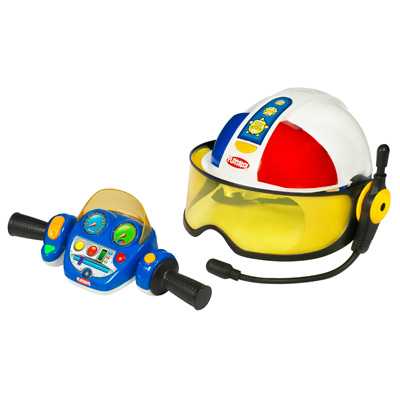
This morning I was passing through my local Wal-Mart Supercenter when I spotted something amazing; something cool; something to make a small child’s eyes grow wide with wonder.  I saw PlaySkool’s Kota the Triceratops.  I’m guessing somebody in R & D finally said, “Enough with the ponies—I want to ride a dinosaur!”  And they were not alone.

I’ve always loved Radio Flyer spring horses and the quarter-driven kiddie rides outside of grocery and department stores (Ole Paint, Brown Thunder, and Trigger—straight from the Double R Bar Ranch).  They were all the prompt my imagination needed back when I was watching Roy Rogers, Zorro, the Lone Ranger and the Cisco Kid.

But what kid is watching Westerns today?  Now the horses are more often ponies—with pink and glitter and real hair manes that you can comb.    Okay, sometimes they’re more like the Breyer Horses  but those aren’t for riding.  A kid needs adventure.

Enter Kota the Triceratops who reacts to touch and sound, and comes with leafy greens that he will munch when you feed him.  Take a look at the demo.   You can ride him (safely, thanks to the handle discretely placed behind his frill).  You can roar at him.  You can tickle his belly.  He even plays “dinosaur adventure songs.”  All this for only $300 and 6 D cells.

Riding toys are some of the best toys ever.  Think pedal cars, Cozy Coupes, Big Wheels, and one of my favorites, the Angel Fish rocker.  Lots of toys involve your hands and your brain, but riding toys are full-body toys.  Which leads to their one big problem: riding toys are BIG and when I was a kid, no matter how much you begged (especially if you already had a tricycle) your parents were bound to say, “There is no way we’ve got room for that!”

So I learned to be grateful for the church nursery and the shopping center and the friends with garages.  But now I’ve got my own house.  And Kota’s only 40 inches long.  Maybe if we get rid of the refrigerator….
Moving

We’re getting down to the wire here. Packers and a moving van are scheduled. The fridge is getting empty. Boxes fill my house and my storage unit. I’m saying, “See you later,” to all my friends. But the thing that told me this move was really going to happen was turning in my library books.

Library books represent possibility—all the interesting things you’d like to explore when you get the time: beautiful pictures, intriguing ideas, the promise of a better you. Maybe you checked one of them out on a whim months ago. Then the book you thought you’d get to soon became an unfinished task that sat on your nightstand beckoning.

When you start taking your library books back, you’re admitting it’s over. There’s no more time. Maybe another day, from another library, but for now, these books will not be read. And so this week I’m letting go of possibilities—forced into honesty—and setting off to a new place with only what I own.

Driving Lessons

My son, my oldest, my-first-to-leave-the-nest has gotten his driver’s license. The teaching-your-child-to-drive experience was good for me. I had to think about and explain thoughts and actions that had been second nature for years. I had to be patient, alert, supportive, and willing to let go. This was all good. But there’s always a downside it seems, and teaching my son to drive turned out to be like so many other big life lessons: a tension between repeating over and over Always Do the Right Thing and admitting that Many Other People Will Not. They will not, but you must. Monitor your own behavior and beware.

As we became more and more adventurous, moving out of the subdivision and onto the main roads, I found the “defensive driving” mantra insufficient—emotionless, as if the roads were filled only with good people who sometimes make mistakes. When it was my child on the highway I called it “Scanning for Idiots.” You know—the people who go the wrong way down the one-way lane in the parking lot; the ones who don’t use their turn signals, or signal left and go right; the people who drive as if the rest of us were merely pylons on their personal race course. I see them so often they hardly register. But now I had to point them out, “Watch out, there’s another one!” It felt like we were in a video game with zombies lurking in the shadows. It made me uncomfortable to be so suspicious. I hated to be so cynical of human nature. I hated letting another polite fiction—the one about how adults behave responsibly—go up in a puff of smoke.

You start with “Don’t talk to strangers” but the lesson goes on and on. Look around before you step out into the meadow.

Getting to know you

If you want to get to know someone, and you’re a bookish person like me, one of the first things you do when you visit someone’s house is take a look at their shelves to see what books and media they’ve got and how it’s arranged. If you’re lucky they’ll leave the room for a few moments so can can peruse in peace, but if not, there are ways of scoping things out unobtrusively. And if that doesn’t work, you can just ask them to tell you about their collection, but it’s probably more fun to start by looking things over on your own.

So it should come as no surprise that on a recent trip to Baylor University I found myself walking through the reference stacks. As you probably know, a reference collection is a different creature from a circulating collection. Reference books are the things you’ve got to have on hand at all times–even if they don’t get used very often. Reference books may be of historical significance, or they may be used so often that you’ve decided to hold back one copy for photocopying and note-taking in the building. And librarians are generally a bit more selective with a reference collection, because most books need to earn their keep by circulating. So a book on the shelf tells you one thing, and a book on a reference shelf tells you a little something else.

That morning I wandered through the music books and the art books, cruised through some general business books, and soon arrived at the history section. I looked at books about Georgia, Louisiana (I looked for Huey Long), and then I found the Texas books. This was the education I needed, and here’s a sampling of what I found:

The Alamo and the Texas War for Independence (Nofi)

Der Texanische Unabhängig-Keitskrieg: 1835/36 (Reichstein)

Hood, Bonnet, and Little Brown Jug (Brown)

The Poet President of Texas (Siegel)

Jeff Milton: A Good Man With a Gun (Haley)

If I Can Do it on Horseback (Hendrix)

The Land, the Law, and the Lord: The Life of Pat Neff (Blodgett, with a forward by Governor Ann Richards)

George W. Littlefield–Texan (Haley)

Bill Clements: Texian to His Toenails (Barta)

Cannibals and Condos (Maril)

Flaming Feuds of Colorado County (Reese)

This Stubborn Soil (Owens)

The Texas Rangers (Webb, 4 copies)

Gunpowder Justice: A Reassessment of the Texas Rangers (Samoa)

The Howling of the Coyotes (Wallace)

I’ll Die Before I Run (Sonnichsen)

I Married a Cowboy (Reeves)

and

The Thorny Rose of Texas: An Intimate Portrait of Governor Ann Richards (Shropshire)

I sense that my love of storytelling and my appreciation for colorful characters will be well-satisfied in Texas. It’s certainly going to be an adventure. I’ll keep you posted.

Save a book

It is a sad fact but true, that books are being published faster than libraries are being built. R.R. Bowker reports that over 291,000 new books were published in 2006. That’s 33 books per hour 24/7, 365 days a year. And that’s a lot of books.

Now, it is also true that most folks like to read the new stuff, but don’t necessarily want to buy it. There are a lot of titles that you’d never want to read more than once, and even more that you’ll find you never want to finish—you only want to look at them for a few days just to see what all the fuss is about.

But libraries struggle to satisfy public demand in this kind of market, because even in libraries it’s all about real estate. There’s only so much space. You can think of it like a grocery store—how many of these do we have to sell (or check out) before we switch to a different product?

How many new copies of Harry Potter or The Appeal or In Defense of Food do we need to have on the shelf? How long should folks have to wait to read a bestseller? And what about those titles that the schools are always assigning: To Kill a Mockingbird? The Scarlet Letter? If the schools aren’t buying enough copies for all their students (and I assure you they are not), how much responsibility does the taxpayer-funded public library have to fill the gap? How much shelf space do these books get?

And what about titles that everybody should read at least once in their lives? Would you want your library to be without Charlotte’s Web? Or Make Way for Ducklings? Or Hamlet or even Homer’s Odyssey? How many times do those books need to check out yearly in order to justify the space they occupy?

Currently my library is undergoing renovation, and as we packed up for the big move, we looked at most every book to see if it should be weeded. Here are the rules: If it’s water-damaged, it goes. If there are unknown substances on the pages (Is that peanut butter? mud?), it goes. If the spine is broken, it goes. If it hasn’t been checked out in three years, it’s probably history.

Sometimes it just kills you to weed a book that you know is terrific and no longer in print. You think, could I have displayed this book better? Why didn’t the publisher give it a more attractive cover? (It never had a chance.) And why is this one out of print when everyone loves it so much it’s checked out over 200 times? These are noble books that laid down their lives for the patrons of the public library.

For folks who care about the character of a library collection, these are difficult issues. E-books and The Long Tail and Print On Demand will help, but in the meantime you can do your part. Take a look around your library. If there’s a little-known title that you feel deserves to be kept in the collection—even if you’re not going to re-read it:

Save a book, check it out. And treat it gently.

Job Hunting

About this time last year I was finishing up my first-ever job in retail. I was looking to pick up a few holiday dollars, the libraries weren’t hiring, and, as retail goes, a bookstore is the place to be. It was, however, a learning experience for a librarian with a degree in art history. I am firmly convinced that everyone in America should have to work retail at least once in their life. Community service is good too, but you learn things on the other side of the register that you won’t learn anywhere else.

So here’s a letter I sent out to some friends while I was still trying to get hired.

——

Yesterday I applied for some part-time/temporary/seasonal hours (could it be any more provisional?) at the local bookstore. I gave them a copy of my resume at the store, but the application itself was filled out online. Such an application! After all the usual stuff about work experience and “Are you a convicted felon?” and “When are you available?” there was a 37 page personality test. Five questions per page. By the end of it, I was really wondering.

There were the usual kinds of “I work best as part of a team.” (Strongly agree/agree/disagree/strongly disagree) and the “I feel confident about my ability to learn new skills” (Strongly agree/agree/disagree/strongly disagree) questions—asked repeatedly in slightly different forms to check for consistency and strength of feeling. But then there were some strange questions–

“It is wrong to fake being polite.”      (Strongly agree/agree/disagree/strongly disagree)

Now, how can you fake being polite? You are or you aren’t. You either say the words or you don’t. What you feel while you say them is irrelevant. If I am polite to a customer who disgusts me, my disgust doesn’t diminish my politeness or make it inauthentic. WHO THOUGHT UP THIS QUESTION?! Do they even know what polite means? What did they think they were asking?

And what about “I always finish my work no matter what.” Have these people ever had a real life? What if they’re locking the front door and closing the store? What if someone falls down and cuts their head open and there’s blood gushing? What if terrorists come in the front door with uzis? Should I finish stocking the displays before I put my hands in the air? What is this “no matter what” talk?

And then, right in the middle of a bunch of innocuous job behavior questions they come out with

“It is so annoying when judges let guilty criminals go free.” (Strongly agree/agree/disagree/strongly disagree)

I just answered the questions and clicked on submit. I hope they think my high school grade average was sufficient.

I’ll keep you posted.

Camo Nation

Camo Easter Eggs Camo Dog Tank top

Camo is the new Tie Dye. It’s everywhere: camo print shirts, camo print pants, camo backpacks, camo bedsheets (do these disguise the bedroom or just the clutter?), even camo Easter eggs (for X-treme hunts!), Camo comes in Forest, Desert or Urban Jungle, Blue or Pink, Brown or Green, Black and Grey.

But here’s my question: what does it mean? When I was a kid, folks who went hunting, or soldiers, or little boys who dreamed they were soldiers wore camoflauge. Now everybody wears it—on fashions that don’t look remotely like hunting gear or army surplus. Hard Rock Barbie wears camo (“Hard Rock’s Barbie® Pink steals the spotlight in a pink camouflage ensemble with skull and crossbone motif. She’s not your mama’s Barbie®!”) Babies can be fashionable in their “camonesies.” Even your dog can get a camo tank top.

Fabric patterns and prints are like wearable fonts-they convey a mood, an attitude. Is this communication a Comic Sans MS moment, or is Times New Roman more appropriate? How would you have to feel to wear a Houndstooth Check? Argyle? A Burberry Plaid?

People are talking all the time—even when they don’t speak a word. So what does it mean when a nation moves from tie dye to camo?

Camo Baby      Tie dye onesie

The case for dinos

Parasaurolophus 

I love dinosaurs—and not just because huge creatures roaming the earth is one of God’s coolest ideas ever.  Or because their variety and strangeness is endlessly fascinating.  Or because the story of their discovery is filled with colorful people and tremendous drama.  I love dinosaurs because they are a nearly perfect occasion for learning to love learning. 

Think about it.  Dinosaurs can motivate small children to master very big words.   Three and four-year olds have no difficulty at all with carnivore or herbivore or parasaurolophus or pachycephalosaurus.  They relish the challenge of specific knowledge.  They love being an expert.  And then, before you know it, they start to think about etymology:  “Did you know that “Rex” means “King?” And “–saurus means “lizard” and there are lots of “sauruses” to learn about, but there’s also velociraptor the “swift thief” and oviraptor the “egg thief” and did you ever wonder why they’re called raptors the same way eagles and hawks are?”  

I love dinosaurs because they open the door to lots of other fields:  animal behavior, biology, zoology, taxonomy, genetics, geology, fossilization, history, biography, climate change, and technical drawing.  With dinosaurs you can talk about how animals’ teeth are related to their diet.  You can talk about how some dinosaurs lived as solitary creatures and others organized into groups.  You can look at the layers of earth you see at a nearby construction site and think about the age of the planet. You can even talk about astronomy when you get to the part about giant meteors crashing into the Yucatan.  Dinosaurs lead children to ask, “How do we know that?” and the answer “Because of what we’ve learned about other things and applied to this field of inquiry” brings home the all-important notion that things are connected.  If you want to fully understand something, you’re going to need to learn about a lot of other things too.  If all you know is Victorian poetry, then you don’t really know Victorian poetry.

I love dinosaurs because our understanding of them is changing all the time.  You can read stories about new discoveries and new theories almost every month. When you study dinosaurs you learn that science is not a static thing.  What you “know” today may be modified, refined, or discarded in time, and a good scientist is not afraid to have his or her ideas challenged and tested. 

And I love dinosaurs because they remind us that we are not the only creatures to walk the earth.  Dinosaurs can keep us humble.  If something that big and powerful was once here and is now gone, then why should we think we’re always going to be here?  Why should we think that nothing’s going to change?  Why should we take this life and this planet for granted? 

Curiouser and curiouser…

With very little provocation I could go on a rant about how the industrial model has created a mind-numbing system of American Public education, but I’ll settle for a small kvetch. We all know that teachers have very little opportunity for personal creativity in the curriculum these days given the great number of standardized tests that students are taking—be they for Accelerated Reading or Standards of Learning or Benchmarks or Advanced Placement or SAT. It’s a ridiculous way to try to educate people, and what causes me the most anguish is way we effectively quench every spark of curiosity in all but the most resilient students.

The NEA reports that children are reading less, but in my experience, people will read if they want what’s in the book: a story, pictures, or information. Can we encourage kids (and grownups) to want to know more? I can only imagine how difficult it must be for a dedicated, concerned teacher to try to keep curiosity burning in a system that presents education as twelve years of conveyor-belt classes laden with prepackaged knowledge satisfying some unnamed test writer who’s not even your teacher.

It’s a mess.

But what is the practical effect of the lack of curiosity? Why do we need the average person to be curious? Why would we want people asking questions all the time? Isn’t it enough just to make sure everyone masters some core information?

A recent article in the Washington Post told the story of a man who endured a six-year headache and spent tens of thousands of dollars trying to find the answer to his medical problem. In the end, it was the patient’s persistence and his own research that resolved the case. Here’s the last paragraph of the article:

Lee Nelson said the experience has radically altered his view of doctors. “I’m very thankful I had the [financial] resources and the gray matter to do what I did,” he said. “But I think that a lot of physicians have lost their intellectual curiosity and don’t want to work with a patient.”

When people stop being intellectually curious, when they stop asking questions, then the doctors only see what they are looking to see, and the car mechanic will never hear that sound you’re describing, and the librarian will do one or two searches with a couple of keywords and say, “I’m sorry. We don’t have any information on that topic.”

We need ordinary people to be curious and to pay attention to the details of life. We need bank employees who will ask questions about odd checks and nursing home attendants who will notice when a resident seems depressed or unwell or in need of new glasses and not chalk it up to being “old.” We need each other to be curious, attentive, and creative. It’s not just something for a few intellectuals or artistic types. Asking questions and paying attention—being curious—make a difference, for all of us, every day.